
Why One Piece Is Becoming One of the Biggest Trading Card Games
The One Piece trading card game has quickly become one of the fastest-growing TCGs in the hobby market. Since launching in 2022, the game has expanded across global tournaments, collector markets, and retail shelves. What began as a franchise extension has turned into a serious competitor in the trading card industry alongside Pokémon and Yu-Gi-Oh.
Its growth comes from several converging forces: the expansion of anime merchandise, strong organized play, rising collector demand, and constant exposure from one of the largest anime franchises ever created.
The Growth of Anime Merchandise
The rise of the One Piece trading card game mirrors a broader surge in anime merchandise worldwide. Anime has moved from a niche subculture to a mainstream entertainment category with global demand for collectibles, figures, and trading cards.
- Anime merchandise markets are growing rapidly as streaming platforms expand audiences.
- Major franchises now rely heavily on licensed products beyond manga or anime.
- Trading cards provide a low-cost entry point for fans to collect their favourite characters.
The One Piece brand already spans anime, films, games, apparel, and collectibles. When a franchise has that level of visibility, physical merchandise tends to follow the same trajectory. Trading cards simply became the next logical category.
The Tournament Ecosystem Is Expanding Fast
Competitive play is one of the biggest drivers behind the growth of the One Piece trading card game. Bandai built an organized tournament structure that resembles the systems used by Pokémon and Yu-Gi-Oh.
Local game stores run weekly events, regional qualifiers feed into championships, and world-level tournaments give competitive players something to aim for.
- Store championships and league play build local communities.
- Regional events attract hundreds of players.
- International championships create prestige and media attention.
Bandai has actively supported this structure through promotional cards, prize support, and large festival events. By 2025, thousands of players were registering for qualifiers across multiple regions.
That ecosystem keeps the game active between product releases. Players need cards to compete, and that drives consistent demand across each new set.
Collectors Are Entering the Market
Another factor pushing the One Piece trading card game forward is the collector audience. The hobby no longer consists only of competitive players. Many buyers treat cards as collectibles or long-term assets.
Several trends explain this shift:
- Anime fans collecting favourite characters
- Speculators buying sealed booster boxes
- Investors chasing rare alternate-art cards
- Content creators showcasing rare pulls
Certain chase cards have reached thousands of dollars on the secondary market. Booster boxes from popular sets have also spiked far beyond retail prices due to demand and limited supply.
This collector behaviour creates additional momentum. Even people who do not play the game still participate in the market.
Popular One Piece Cards
Monkey D. Luffy (OP05-004)
Shanks (OP09-004)
Boa Hancock (OP07-051)
Monkey D. Luffy (EB02-061)
Yamato (OP01-121)
Edward Newgate (OP02-001)
How It Compares to Pokémon and Yu-Gi-Oh
The One Piece trading card game still sits behind the two giants of the industry: Pokémon and Yu-Gi-Oh. Those games have decades of history and enormous global audiences.
However, the growth trajectory of One Piece is unusually fast for a new TCG.
| Game | Launch Year | Main Strength | Market Position |
|---|---|---|---|
| Pokémon TCG | 1996 | Massive global brand | Largest trading card game |
| Yu-Gi-Oh TCG | 1999 | Competitive scene and nostalgia | Long-standing competitive community |
| One Piece TCG | 2022 | Rapid collector growth and anime exposure | Fast-rising modern TCG |
Even though Pokémon still dominates sales, the One Piece card game has become one of the fastest-growing TCG products for Bandai.
Anime Exposure Drives Merchandise Demand
One of the biggest advantages behind the One Piece trading card game is constant media exposure.
Unlike many franchises, One Piece continues to expand with:
- Ongoing anime episodes
- Feature films
- The Netflix live-action adaptation
- Video games and collaborations
- Large international fan events
Every new release renews interest in the franchise. That attention spills directly into merchandise demand, including trading cards.
This cycle repeats itself regularly:
- New anime arc or film releases
- Fans return to the franchise
- Merchandise demand increases
- Trading card sales follow
Few franchises have a media ecosystem large enough to sustain that loop. One Piece does.
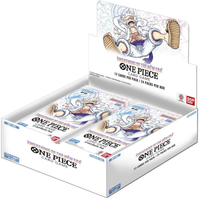
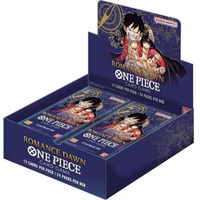
Featured One Piece TCG Products
Top picks for chase cards

The Future of the One Piece Trading Card Game
The One Piece trading card game is still early in its lifecycle. Compared with Pokémon or Yu-Gi-Oh, the game is only a few years old. Yet it has already developed a strong collector base, an organized tournament system, and a rapidly expanding player community.
If current trends continue, several outcomes are likely:
- More international tournaments
- Higher collector interest in rare cards
- Expansion into additional markets
- Greater competition with established TCG giants
Whether it eventually rivals Pokémon remains uncertain. But the direction is clear: One Piece is no longer just another TCG. It is becoming one of the defining trading card games of the present day.


![One Piece 500 Years In The Future (OP-07) Booster Box 24 Packs [English]](http://tcgking.nl/cdn/shop/files/One-Piece-OP-07-500-Years-In-The-Future-Booster-Display-24-Booster-Packs.png?v=1773610122&width=120)
![One Piece A Fist of Divine Speed (OP-11) Booster Box [English]](http://tcgking.nl/cdn/shop/files/One-Piece-OP-11-A-Fist-Of-Divine-Speed-Booster-Box.jpg?v=1773610123&width=120)
![One Piece Carrying on His Will (OP-13) Booster Box [English]](http://tcgking.nl/cdn/shop/files/OP13.png?v=1762852658&width=120)

![One Piece The Best Premium Booster (PRB-01) Booster Box [English]](http://tcgking.nl/cdn/shop/files/One-Piece-PRB-01-The-Best-Booster-Display-24-Booster-Packs.png?v=1773610123&width=120)

![One Piece Anime 25th Collection Extra Booster (EB-02) Booster Box 24 Packs [English]](http://tcgking.nl/cdn/shop/files/One-Piece-EB-01-Anime-25th-Collection-Booster-Display-24-Booster-Packs_78905c33-af5c-466c-a91d-50005fa8b3f6.jpg?v=1773610122&width=120)
![One Piece The Best Vol.2 Premium Booster (PRB-02) Booster Box [English]](http://tcgking.nl/cdn/shop/files/One-Piece-PRB-02-The-Best-Vol2-Booster-Display-24-Booster-Packs_5b364a67-317d-48cd-a7ed-659fde1428fe.png?v=1773610123&width=120)


